No more damp ceilings or leaking joints
Watertight flat roof membranes and resealed joints
Degraded seams and cracked detailing are sealed with flexible, heat-resistant waterproofing materials. Flat solariums and roof sections remain fully watertight against persistent standing water and sudden downpours.
Clear scuppers and downpipes free of calima sediment
Cleaned roof gullies and drain outlets discharge storm runoff rapidly away from vulnerable parapet junctions. Water never pools or backs up behind dirt dams under the eaves.
Curved terracotta tiles securely bedded and aligned
Damaged tiles are replaced and bedded into resilient mortar along straight roof courses. The entire structure resists shifting from strong Mediterranean winds and remains mechanically stable.
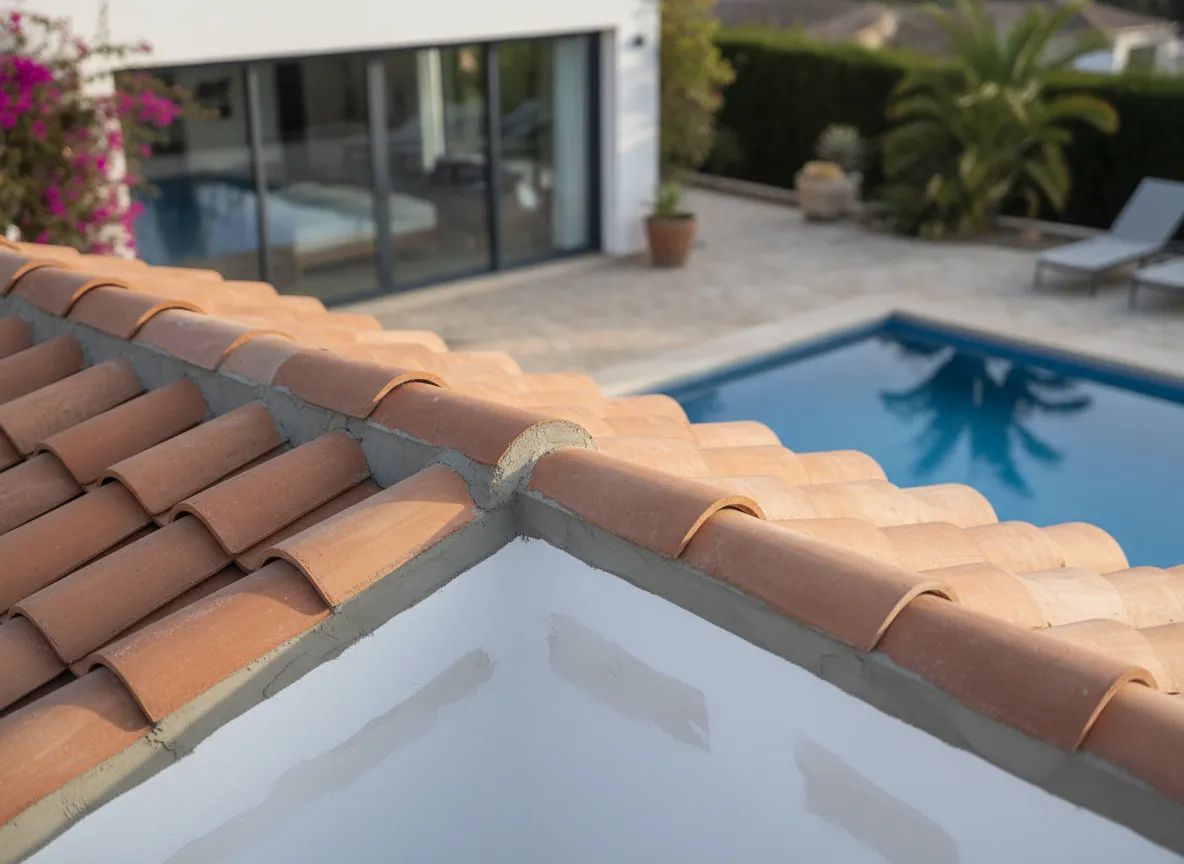
Curved roof tiles crack under thermal stress and slip down the roof pitch during gusty coastal winds. Rain then bypasses the primary barrier and saturates the underlayment.
Trapped water seeps into structural timber framing and ceiling plasterboards while the villa stands empty for months. Stained interior ceilings and peeling paintwork quickly turn into expensive interior renovation projects across Marbella.
Fine calima dust mixes with dried debris in valleys and drainage scuppers, forming solid blockages. Heavy winter downpours back up behind these dams, driving water directly behind parapet flashings and soaking outer render.
How a proper roof restoration is carried out
Roof surfaces are inspected systematically — We check every tile course, ridge line, and perimeter parapet for cracks, displacement, or degraded bedding. Solar mountings and pipe penetrations receive close diagnostic attention.
Damaged and loose tiles are removed — We lift broken curved terracotta tiles carefully without disturbing surrounding sound courses. Debris and fractured sections are cleared down to the base substrate.
Drainage channels are cleared completely — We clear silt, loose sand, and degraded mortar from all internal valleys. Water runs unimpeded toward gutter repairs or collection outlets.
Substrate membranes are repaired and sealed — Exposed deck areas receive fresh, UV-stable waterproof membrane underlayment. We hot-air weld or bond all seams with elastomeric compounds to ensure a continuous seal.
Ridge and hip tiles are re-bedded — We reset ridges in flexible, weather-rated mortar that tolerates building expansion without cracking. Proper spacing ensures clean alignment along the structural roof ridges.
Wall flashings are mechanically dressed and sealed — We dress lead and zinc aprons around chimneys and parapets flat against the facade render. Joint edges are anchored and sealed with structural polyurethanes.
Valleys and outlets undergo controlled water testing — We soak repaired gullies and tile courses using controlled water flows to inspect drainage speeds. Every junction must prove watertight before work concludes on site.
We cover the Costa del Sol
Roof maintenance and repairs are carried out on detached properties throughout the region. Every location from coastal slopes to hillside communities receives scheduled inspections and prompt repair services.
Is this what you are looking at?
Loose tiles sliding down the slope
Intense summer heat dries out the underlying bedding while gusty sea winds gradually loosen exposed edges. Individual sections can be secured in place if adjacent rows remain straight and unbroken.
Bent zinc flashings pulling off walls
Daily temperature swings cause metal aprons along chimneys and parapets to expand, pull their fixings, and warp. These joints can be reshaped and resealed before heavy rain gets underneath.
Stagnant pools sitting on flat decks
Slight structural settlement creates low dips where rainwater collects instead of running freely into drains. Leveling the hollow and renewing local seals usually restores proper fall across the deck.
Crumbling grey mortar under ridge caps
Direct sun bakes old cement joints until they turn brittle and crack away under normal villa vibration. The caps can be lifted and reset before open gaps allow rain into the attic space.
Damp yellow rings on bedroom ceilings
Hidden cracks in upper waterproof layers let slow leaks travel across concrete slabs before soaking through plaster. Finding the roof breach early stops ceiling decay before full plaster boards collapse.
Does your villa need steady exterior care?
Response time: 24 hoursSatisfaction guarantee
New metal joints or flexible sealing paste
Water leaks near chimneys, valleys, or parapet walls often tempt people to spread liquid rubber or mastic paste across visible seams. Surface paste covers up the gap immediately, but heavy heat and intense sunlight quickly degrade sticky compounds. As building materials expand and contract during scorching afternoons, mastic hardens, tears open, and lets water slip through unnoticed. A minor flashing repair takes between 2 to 4 hours to carry out properly, whereas repeatedly spreading sealant over split materials only hides ongoing moisture intrusion.
Water frequently travels along structural rafters or underlay before dripping down into the living space, making pinpoint patches ineffective. Sheet metal flashings made of zinc, lead, or aluminum provide decades of service life when formed with proper expansion room. Relying on temporary paste instead of shaped metal joints exposes underlying roof battens to persistent leaks, which eventually rots structural timber and leads to costly structural carpentry down the line.
Tile swapping or coating paint over old surfaces
Aged clay or concrete roof tiles often show surface wear, patchy discoloration, or fine hairline flaws after years of sun. Liquid elastomeric paint is frequently sold as an easy all-in-one fix to refresh the roof without moving a single piece. However, spraying a synthetic coating over brittle tiles does nothing to fix broken profiles or deteriorated roof battens underneath. Replacing cracked tiles individually takes between 2 to 4 hours for simple sections and keeps the factory drainage channels functioning as intended.
Applying a thick surface coating seals tile edges together and traps evaporating moisture underneath the surface. Trapped condensation cannot escape through breathable membranes, leading to damp build-up in structural timber framing. Well-maintained clay tiles last for several decades on their own when air circulates freely beneath them. Covering damaged units with liquid paint turns isolated cracks into widespread sub-roof decay, creating severe structural timber damage that requires stripping the entire pitch later.
Torched bitumen membranes or cold applied adhesives
Our on-site inspection determines how flat roof sections must be sealed and how water moves beneath the tiles. For flat areas, the timber substrate and surrounding structural conditions decide the bonding method. When certified hot-works safety clearances and fire-watch procedures can be established safely over the timber deck, torch-on bitumen felt provides a seamless barrier. If timber structures lack these strict clearances, the job shifts to cold-applied adhesives, which removes fire risks but adjusts the material costs and curing time on the estimate.
We also trace damp patches visible on ceilings back to their real point of entry during the inspection. Water frequently enters a broken tile high up the roof slope and travels down rafters or breathable underlay before dripping through. Tracing this actual runoff path means the quote targets the true opening further up the roofline, instead of merely quoting for localized work directly above the stain.
Your questions, answered
Which materials are chosen for a roof repair? +
We match clay or concrete tiles to the existing profile and weathering, while bituminous felt suits flat sections. Joints around roof features require formed metal such as zinc or lead. The roof pitch and construction type decide the final combination.
What extends the life of a roof repair most? +
Keeping structural timber completely dry and free from rot protects the fix longest. On the Costa del Sol, intense thermal movement breaks cracked mortar quickly if ridge caps are not maintained. Fast action prevents damp spreading to battens.
Where can money be saved on roof repairs safely? +
Replacing individual tiles early avoids rebuilding entire timber sections later. Minor tile or flashing work takes just 2 to 4 hours. Skipping rotten timber repairs under broken tiles creates major structural costs down the road.
How can you tell if previous roof work was done badly? +
Water tracking along rafters far from the entry point usually exposes failed laps in the underlay. Incorrect mechanical fixings on metal joints also cause buckling. If underlying wood remains damp, the repair must be opened and remade.
Can new materials be installed alongside existing roofing? +
We can integrate breathable underlay membranes under tiles if existing battens remain fully sound. Torch-on felt can also bond to clean, dry field membranes. No fresh layers should ever cover rotted framework or damp substructures.
How long will a roof repair hold up? +
Metal flashings with proper movement joints last for decades. In older villas in Marbella, well-maintained clay tiles endure for generations if water is kept off sub-roofs. Bitumen patches generally have shorter lifespans and require earlier renewal.
What happens if I am not happy with the roof repair? +
Satisfaction guarantee. If you are not happy with a result, tell us and we come back to put it right.