No leaks, crumbling grout, or hollow tiles
A watertight pool shell
Hydrostatic pressure testing and reinforced waterproof tanking ensure the pool retains every drop outside natural evaporation. Sub-terrace soils remain stable and pool equipment functions without unexpected water loss.
Secure tiles and clean grout
Flexible adhesives and two-component epoxy grouts lock every mosaic firmly into position. The smooth, non-porous joints resist salt chlorinator erosion, do not snag bare feet, and deny algae a place to settle.
Zero calcium scaling and hollows
Thorough removal of drum-sounding render eliminates hidden hollows behind the pool finish. Pristine tile surfaces remain free of heavy mineral crusts and provide sharp, clean edges along every step and bench.
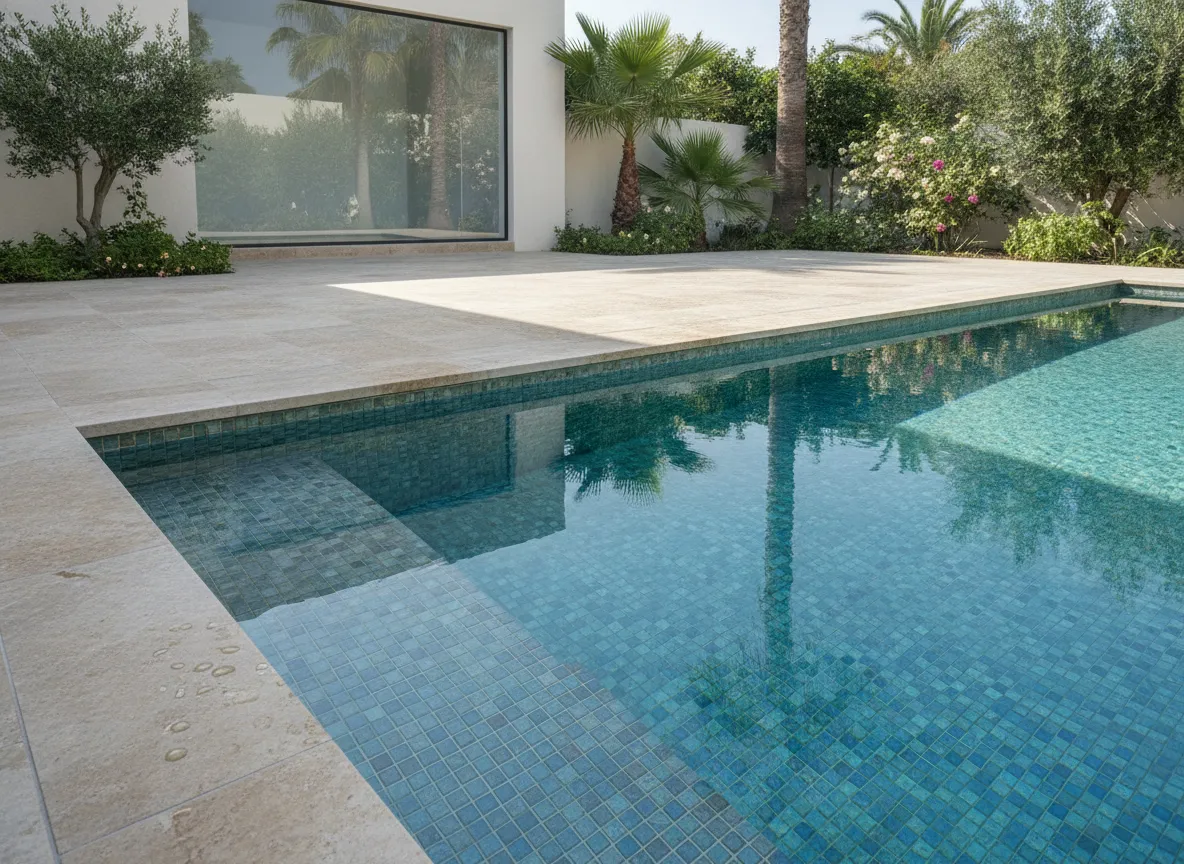
Sun-degraded expansion joints and hairline cracks let chlorinated water seep behind the tile bed. Trapped moisture weakens bonding mortar. Hollow pockets form, causing entire sheets of gresite mosaics to blow off the concrete.
Escaping water migrates into the underlying terrace sub-base. Soil washout causes terrace slabs around properties in Marbella to settle and crack. A minor shell fracture quickly turns into major structural paving repairs.
Empty villas with unnoticed leaks run filtration pumps completely dry while owners are away. Burned-out motors and empty basins expose bare render to intense sun. This multiplies shell damage and repair costs before return.
The technical procedure behind durable basin refitting
Draining the basin — We evacuate water fully using submersible pumps. Technicians immediately run static pressure tests across skimmer, drain, and return circuits.
Stripping loose surfaces — We chip away cracked tiles, hollow plaster, and crumbling mortar down to sound concrete. Mechanical preparation ensures the new bonding coat adheres properly.
Stitching structural cracks — Fissures across the shell are ground into clean channels and pinned with carbon rods. We fill voids with high-strength structural epoxy resin to restore shell integrity.
Applying waterproof tanking — We apply a two-coat polymer-modified cementitious waterproof slurry over the prepared shell. Curing creates an impermeable barrier against sub-surface water migration under hydrostatic pressure.
Setting new tiles — We embed porcelain slabs or glass mosaics using flexible C2TE S1 adhesive. Laser levels ensure straight geometric sightlines across steps, floors, and corners.
Injecting epoxy grout — We pack joints with chemical-resistant two-component epoxy grout instead of porous cement. This material resists salt chlorination and prevents black algae from settling.
Fitting integrated hardware — Return jets, underwater LED niches, drain grates, and skimmer mouths are bedded flush. We install fresh elastomeric gaskets to prevent leaks at shell penetrations.
Balancing pool water — Fresh water fills the basin before chemicals stabilise pH, alkalinity, and calcium hardness. We inspect the pool filter and pump maintenance setup before starting circulation.
We cover the Costa del Sol
Coverage spans coastal and hillside residential properties from the eastern edge of the area through to the western municipal boundaries.
Is this what you are looking at?
Loose mosaic tiles on steps
Foot traffic on underwater edges stresses aged bonding beds until individual pieces lift. Prompt resets protect swimmers from cuts, though extensive loosening usually calls for rebedding the full flight.
Thick white crust along waterline
Intense summer heat evaporates mineral-heavy pool water right at the tile edge. Controlled descaling washes the band away, provided hard buildup has not permanently etched into glass glazes.
Cracked grout around pool lights
Vibrations and thermal expansion pull fittings slightly away from surrounding mosaic borders over time. Flexible marine sealants close these vulnerable junctions before deeper voids form around internal light niches.
Uneven tiles catching toes underwater
Ground movement shifts older basin bases and leaves mosaic edges protruding into swimming lanes. Spot grinding levels mild ridges safely, but broader displacement typically requires lifting the uneven floor section.
Sudden dropping water level overnight
Concealed structural splits or ruptured pipe connections drain water past normal evaporation rates on hot afternoons. Dye tracking identifies the exact breach immediately, preventing washed-out ground beneath surrounding sun terraces.
Does your villa need steady exterior care?
Response time: 24 hoursSatisfaction guarantee
Standard pool tiles or small glass mosaics
Retiling a swimming pool brings an immediate decision between standard fully vitrified ceramic tiles and small glass mosaics. Fully vitrified ceramic units cover substantial surface area rapidly. In contrast, small mosaics require significantly more labor hours per square meter to align sheets, adjust delicate joints, and maintain an even bed across walls and curved pool floors.
For a standard basin, setting ceramic tiles generally takes 4 to 8 working days. Choosing small glass mosaics extends this installation schedule substantially. Demanding site features such as steps, benches, and infinity edges multiply the hours required to cut and level tiny mosaic sheets. The total labor bill reflects this added installation time directly.
Standard vitrified ceramic tiles suit projects where labor budgets and faster handover dates govern the schedule. Our recommendation is small glass mosaics for projects where extended installation times and higher fitting costs fit comfortably within the renovation plans.
Epoxy grout lasts longer than cement grout
Pool water requires regular sanitation, shock dosing, and chemical management to remain clean under intense Mediterranean sunshine. Grout lines sit in continuous direct contact with these treated liquids. The choice between a two-part epoxy grout and a dedicated polymer-modified cement grout determines the long-term durability of every submerged joint.
Epoxy grout material costs significantly more than cement mortars upfront, yet it provides total resistance to chemical dosing and chlorine. A fully vitrified tile installation finished with epoxy grout can last 20 to 30 years without joint degradation. Polymer-modified cement grouts cost less to buy, but treated pool water gradually erodes cement binders over time.
A cementitious installation typically requires raking out and repointing after 7 to 12 years due to chemical erosion and joint thinning. Selecting cement grout suits projects prioritizing lower upfront material costs, while we recommend epoxy grout for installations planned for decades of chemical resistance without early joint repairs.
Waiting the full curing window before refilling
A pool shell looks completely transformed the moment the tile joints are sponged clean. It is a common misconception that tiles and grout alone create a waterproof barrier, or that a basin is ready for water as soon as surfaces dry to the touch. In reality, modern bonding mortars and epoxy jointing compounds require complete chemical cross-linking before handling continuous hydrostatic immersion.
The technical data sheets for epoxy and cementitious systems strictly require 14 to 21 days of full cure before refilling. During this window, structural repairs, bonded waterproofing slurries, and tile mortars gain their certified bond strength. Temperatures between 5°C and 25°C must be maintained, shielded from harsh sun and drying winds.
Rushing the schedule breaks bond strength entirely. Filling early dissolves unlinked polymers, causes tiles to sound hollow, and risks severe debonding that ruins the new finish. Allowing the mandatory 14 to 21 full curing days protects the investment, while rushing requires postponing retiling until the calendar allows the necessary chemical cure.
Your questions, answered
How long does a full pool renovation take from start to finish? +
Our preparation, repairs, and tiling take about 7 to 15 working days. After tiling, the pool must cure dry for 14 to 21 days before refilling. In coastal villas around Marbella, summer heat often requires shaded enclosures to protect this curing schedule.
What condition must the pool shell be in before work begins? +
The concrete shell must be structurally sound, crack-free, and ground down to remove old algae and paint. Working temperatures must stay between 5°C and 25°C. If applied on a crumbling or dirty surface, the new layers will quickly blow off.
Do new pool tiles and grout stop water leaks on their own? +
No, pool tiles and grout are decorative and never hold back water. Containment comes entirely from the bonded waterproof slurry applied beneath the tiles. Across the Costa del Sol, water loss usually happens when this crucial lower barrier was left out.
Which adhesive system works best for an underwater pool installation? +
The choice stands between polymer-modified cement mortars and two-part epoxy adhesives. Cement mortars handle standard installations well. Epoxy adhesive costs significantly more up front, but it provides maximum chemical resistance against harsh water shock treatments and heavy chlorine dosing.
How can you tell if an old tiling job was done poorly? +
Hollow sounds when tapping tiles indicate poor adhesive coverage, while white mineral blooms show water passing behind them. Joints around skimmers and lights also split if cheap fillers were used. We chip away loose tiles and rebuild the substrate before retiling.
How long will a fully retiled concrete pool last? +
A correctly installed system can last 20 to 30 years or more. Cement-based joints naturally erode from chemicals and require repointing every 7 to 12 years. Keeping correct pool water balance prevents early surface breakdown.
What happens if I am not happy with the pool renovation and retiling? +
Satisfaction guarantee. If you are not happy with a result, tell us and we come back to put it right.