The technical standard of completed shade maintenance
Clean fabric without calima silt
Canvas surfaces and tension sails are returned to their original woven tone without muddy watermarks or streaks. Removing fine mineral deposits revives the appearance of terrace dining areas.
Smooth mechanical movement
Sliding louver channels, tension arms, and roller cassettes operate without friction or squeaking. Removing salt crust and road grit protects electric motors from unnecessary mechanical strain.
Hydrophobic protective barrier
Treated fibres actively repel moisture and airborne debris. Future calima dust settles on the outer barrier instead of penetrating yarn. Simple hose wash-downs work between scheduled services.
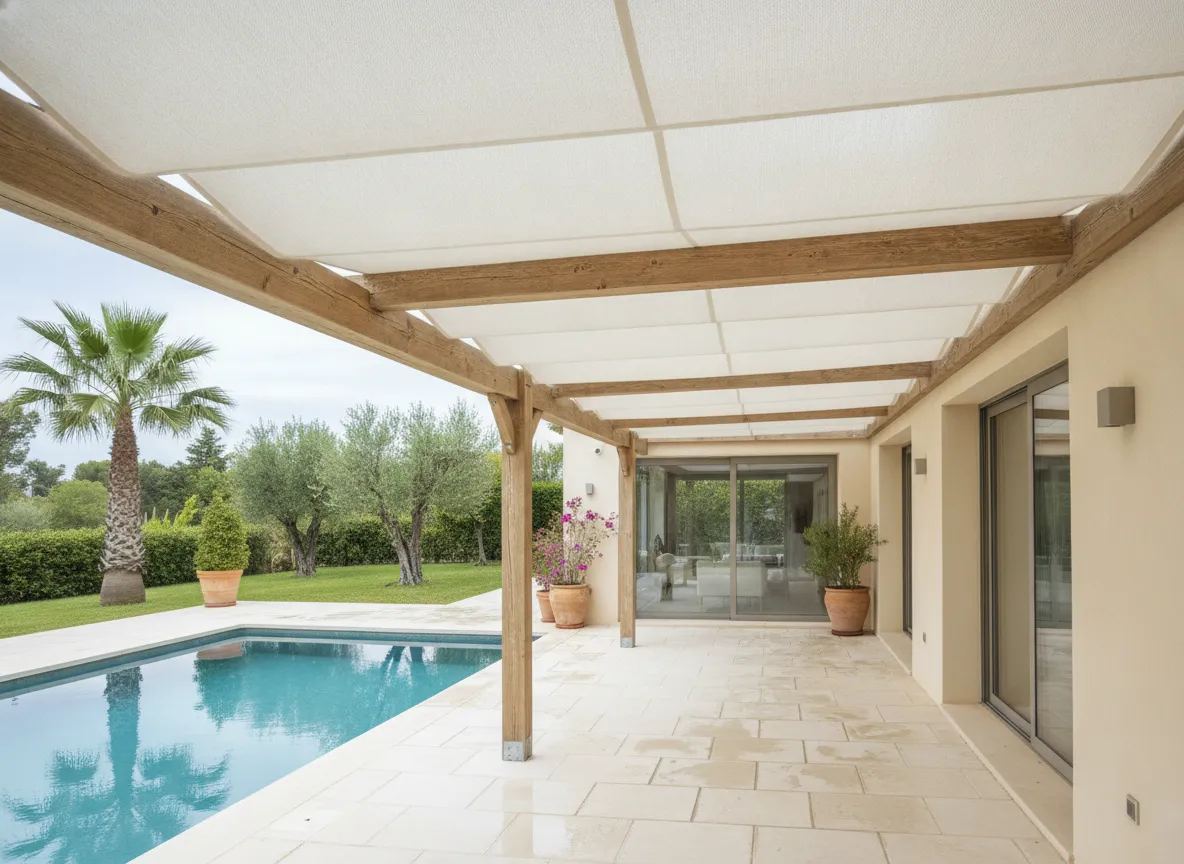
Orange dust from seasonal Saharan winds settles into canvas seams, roller cassettes, and mechanical joints across the Costa del Sol. Combined with morning coastal dew, the fine silt forms an abrasive paste that grinds down internal mechanisms.
Strong Mediterranean sunlight bakes these mineral deposits directly into synthetic fibres. The heat breaks down factory coatings, leaving shade sails brittle and prone to tearing along stress points.
Winter moisture fuels black mould inside rolled awnings. Structural aluminium tracks jam, turning simple shade operation into an expensive structural replacement.
How we restore shade fabrics and structures
Dry debris is removed — We brush down canvas panels, shade sails, and support posts with soft horsehair tools. Removing loose dust and pine needles prevents grit from forming mud during subsequent liquid stages.
Detergent is applied — We spray a neutral-pH biodegradable wash across the entire textile surface and aluminium housing. The solution breaks down bird lime, atmospheric film, and mineral dust without compromising thread integrity.
Stains are agitated — We work embedded calima rings and biological growth loose with handheld, non-abrasive brushes. Seams and hem lines receive targeted passes where damp accumulates. Extra attention is given to degraded stitching.
Residues are flushed — We rinse fabric and metalwork with volume-regulated, unheated water at tap pressure.
Mechanical tracks are cleared — We clean sliding channels, louver pivots, and tension arms of salt crust and grit. Guide channels receive dry lubricant so motorized sections move freely without resistance.
Protective sealant is applied — Completely dried textiles receive a breathable fluoropolymer treatment to restore hydrophobic performance. Water beads immediately, preventing red silt from soaking into the weave during future storms.
We cover the Costa del Sol
Residential properties throughout the coastal corridor and surrounding hillside developments are served regularly.
Is this what you are looking at?
White salt crust along metal tracks
Marine sea mist evaporates on cool aluminium channels each night, leaving stubborn crystalline minerals behind. Hand washing dissolves these deposits completely, provided the metal underneath has not yet started to blister.
Acidic bird droppings on open canvas
Perching birds leave concentrated uric acid that bleaches synthetic dyes under the hot afternoon sun. Spot neutralisation lifts the dark residue, although faint bleached rings often remain on older material.
Green algae stripes in valance folds
Dew settles in the dangling fabric edges where shadows linger past midday. Gentle hand treatment clears the plant growth, restoring clean folds if the bottom hem stitching is still sound.
Black mildew specks under timber rafters
Garden irrigation mist drifts upward into unventilated beams during humid summer evenings. Surface mould washes off sealed timber easily, while unsealed wood usually needs fresh protection after drying out.
Frayed seam threads on shade panels
Intense ultraviolet radiation breaks down standard polyester sewing thread long before the heavy woven fabric fails. Early inspection reveals these snapping stitches in time to arrange restitching before sudden wind rips the panels apart.
Does your villa need steady exterior care?
Response time: 24 hoursSatisfaction guarantee
Gentle manual brushing cleans fabrics without tearing seams
Heavy dirt, airborne dust, and green algae build up on outdoor canvas over time. High-pressure power washers seem like a fast way to blast this layer off, but concentrated water jets blow directly through the woven acrylic fibers. The pressurized blast splits the delicate seams, cuts through aged stitching threads, and forces fabric layers apart. Once this surface delamination happens, water leaks through the canvas permanently, requiring an expensive full fabric replacement or structural pergola, awning and shade repair long before the material should have worn out.
Manual brushing with low pressure protects these vulnerable seams completely. We work a pH-neutral textile cleaner deep into the weave with a soft bristle brush without mechanical trauma. Active cleaning takes 1 to 3 hours, lifting organic grime while keeping the structural threads intact. Applying a protective fluoropolymer treatment right after preserves water resistance for 1 to 3 seasons. Low-pressure washing paired with gentle hand agitation preserves the integrity of the canvas, whereas high-pressure washing destroys the stitching on contact.
Allowing four to twelve hours before rolling away
Washing an outdoor canopy leaves a substantial volume of water held deep inside the woven threads. Retracting the unit immediately after washing traps this moisture inside a dark cassette housing or tight rolled bundle. When wet canvas cannot breathe, mildew spreads across the layers within days. Mold colonies leave permanent dark spots, eat away at natural thread coatings, and cause accelerated rotting that ruins the entire fabric panel. Replacing ruined material because of premature storage adds massive, unnecessary costs to what should be routine maintenance.
Natural air circulation is necessary to pull every trace of dampness from the fiber core. Leaving the canopy fully extended for 4 to 12 hours allows the ambient air to dry both sides evenly. This natural drying window also lets the waterproofing impregnation cure thoroughly against future rain. Waiting until the fabric is bone-dry before operating the retraction mechanism keeps the material free from mildew and rot, while rolling damp canvas straight into a dark casing guarantees mold growth.
Overcast weather gives better results than midday sun
Outdoor awnings and pergolas get dirty from sap, soot, and bird droppings that need soap to dissolve. Scheduling this maintenance under direct midday summer sun causes serious chemical problems. Intense solar heat warms the canvas and frames rapidly, causing water and active detergents to evaporate in minutes. When cleaning solutions dry out before being rinsed, the chemical agents bake directly into the fibers. This creates permanent streaking, discolors the pigment, and forces repeated wash cycles that wear down the surface prematurely.
A dry, overcast day gives detergents the necessary dwell time to loosen encrusted grime safely. Spending 30 to 60 minutes on site preparation and soap application works best when clouds keep surface temperatures down. Cleaning solutions stay wet on the canvas, lifting biological dirt naturally so a light rinse can flush it away. Our recommendation is scheduling the work under overcast skies to prevent cleaning chemicals from drying into the material, whereas direct midday sun bakes detergents into the fabric before rinsing can happen.
Your questions, answered
Does washing fabric automatically keep it waterproof? +
Washing does not leave fabric waterproof on its own. Thorough washing removes existing surface treatments along with the dirt. We apply a dedicated waterproofing impregnation afterwards to restore water repellency and prevent rain from soaking through.
What keeps outdoor covers lasting the longest? +
Applying protective impregnation after washing maintains water repellency for 1 to 3 seasons. The quickest way to ruin an awning is using high-pressure washers, which blast apart fabric seams, or harsh chlorine bleaches that cause permanent color bleeding.
Can all old pergola covers and fabrics be cleaned? +
No, heavily deteriorated structures cannot be washed safely. Fragile fabric where sun damage has rotted the stitching will tear under standard washing. We also reject work if walking directly on unreinforced glass or polycarbonate roofs is required.
Why does cleaning cost vary between different pergola setups? +
Access height and material types dictate the overall labor. For hillside villas in Marbella, multi-level terraces often require specialized access equipment like scaffolding. Heavy-duty woven acrylic also demands deep extraction and waterproofing, which costs more than washing smooth glass.
Is a specific trade license needed to clean awnings? +
Manual cleaning of pergolas and awnings requires no statutory trade license. However, safety regulations strictly govern work at height, requiring proper fall protection and certified platforms. Local environmental laws also govern how wastewater and chemical run-off must be handled.
Where can money be saved on canopy maintenance? +
Keeping surrounding gutters clear saves money by stopping overflow and organic growth before it embeds. Skipping post-wash waterproofing along the Costa del Sol is a costly shortcut, as untreated canvas absorbs damp winter rain, leading to rapid fabric rot.
What happens if I am not happy with the pergola & awning cleaning? +
Satisfaction guarantee. If you are not happy with a result, tell us and we come back to put it right.