A watertight masonry envelope with invisible textured repairs
A completely sealed exterior envelope
Flexible repair mortars close every hairline fracture against wind-driven moisture. Rain sheds off external elevations instead of soaking through porous masonry cores. Substrate materials stay dry, preventing structural decay and internal wall dampness.
Invisible texture and profile matching
Specialist floating techniques blend new mortar transitions directly into existing scraped or monocapa textures. Window reveals, structural corners, and wide elevations retain flat profiles without noticeable repair lines. The completed wall appears uniform and untouched.
Breathable salt-resistant coatings
Elastomeric mineral finishes resist cracking caused by summer expansion and winter damp. Vapour moves freely outwards from underlying masonry while external rain is repelled completely. The coating stays bonded without blistering, peeling, or salt scarring.
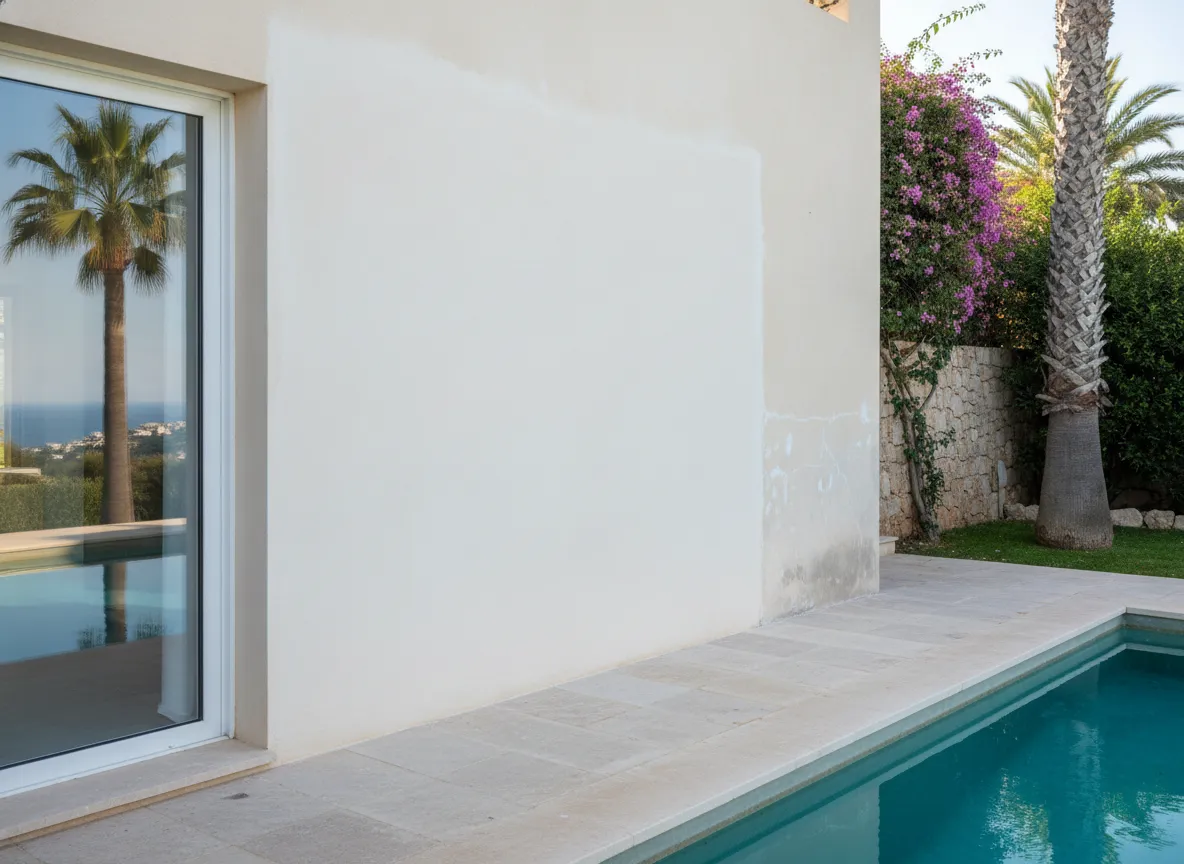
Hairline cracks expand during hot summers as masonry shifts. Winter storms then push driving rain straight through these openings. Moisture settles inside the wall structure. It rots interior plaster, creating damp patches that smell musty before external damage shows.
Trapped moisture behind south-facing walls expands under strong sun along the Costa del Sol. Large hollow pockets develop beneath the paint. Slabs of loose render pull away from structural brickwork. This leaves deep gaps requiring heavy masonry rebuilding rather than basic patching.
Salt air and calima dust deposit minerals into unsealed fissures. Crystallising salts constantly lever the mortar away from underlying blocks. Neglecting minor cracking turns a small spot repair into full scaffolding, complete render stripping, and costly structural work.
Surface preparation that guarantees lasting adhesion
The wall is sounded mechanically — We use a small hammer to check every square metre for hollow voids beneath the paint. Tapping reveals detached plaster that still appears solid. Marking these boundaries ensures no compromised render remains.
Blown render is cut out — We chase straight perimeter cuts around damaged areas using mechanical diamond blades. Chiselling away loose masonry back to solid blockwork stops fractures spreading into healthy sections. Straight boundaries guarantee uniform edge depth for subsequent plastering.
Masonry is cleaned and cleared — We scrub salt efflorescence, loose dust, and degraded mortar beds from the exposed substrate. High mineral build-up prevents new mortar bonding to brick surfaces. A clean core ensures modern compounds grip firmly.
Substrate suction is controlled — We apply an anti-suction primer across dry masonry before mortar application. Porous Spanish brick draws water out of wet render too rapidly, causing shrinkage cracks. Stabilising absorption allows the patch to cure at a uniform rate.
Polymer repair mortar is applied — We fill the void flush to the adjacent level using a flexible, fiber-reinforced repair mortar. Layering thick sections in stages prevents slump within deep wall scars. The mortar flexes naturally alongside structural expansion.
Surface texture is duplicated — We work the mortar with floats, sponges, and scrapers to match textures like monocapa or scraped render. Blending wet edges directly into existing plaster lines hides the transition completely.
Breathable coatings seal the surface — We seal the cured repair with an elastomeric, water-resistant exterior paint against wind-driven coastal moisture. High vapour permeability lets internal damp escape without blistering the paint film.
We cover the Costa del Sol
Repairs cover substantial villas across the coastal corridor, focusing on exterior masonry, perimeter boundaries, and exposed elevations.
Does your villa need steady exterior care?
Response time: 24 hoursSatisfaction guarantee
Is this what you are looking at?
Flaking paint peeling around terrace corners
Trapped ground damp pushes against brittle paint layers on shaded exterior corners. The surface can usually be restored once loose edges are scraped back, though stubborn patches may need extra drying time.
Horizontal cracks along low perimeter walls
Ground movement shifts concrete footings under long decorative boundary runs during dry summer months. The split can be bonded securely if caught before winter rains enter the exposed core.
Crumbling sand falling from window reveals
Direct sun bakes delicate edging mortars until the binding agent turns powdery around metal frames. The edges can be rebuilt neatly, though older aluminium frames might show slight colour variation nearby.
Bulging plaster swells beside roof downpipes
Hidden leaks behind metal pipe clips slowly saturate soft backing coats until the finish detaches. The area can be replastered flush once pipe leaks are resolved, leaving a sound surface for painting.
Diagonal stepped cracks spreading across masonry
Uneven foundation settlement pulls mortar joints apart along natural block lines, signalling hidden structural strain below. The gap can usually be stitched with helical bars, provided underlying ground movement has finally stopped.
How daily temperature dictates when repairs proceed
Exterior wall repairs depend entirely on the weather during application and the drying stage. The materials need stable air and surface temperatures to cure properly without cracking or losing their bond to the masonry. Strong sunshine heats the wall surface well past ambient levels, which pulls moisture out of fresh mortar before it can set.
Repairs proceed smoothly when outdoor temperatures remain between 5°C and 25°C throughout application and initial curing. If daytime heat exceeds 25°C or direct sun hits the wall, working becomes risky. The render dries too fast, causing severe map cracking and shrinkage across the surface. Pushing through high heat leads to premature failure within 1 to 5 years, forcing you to pay for complete removal and a full redo. We postpone work to cooler hours or mild days to ensure the new render cures without structural weakness.
What dictates the quote on site
Our site visit establishes whether your wall needs isolated patch repairs or a full strip-down. Tapping the surface reveals hollow patches where the render has lost adhesion to the structure underneath. When only a small, sound section has cracked, the quote covers a localized patch repair that takes just a few hours. If tapping reveals large hollow sections that have fully detached, your quote expands to complete hacking off of the failed render coat. Leaving hollow render on the wall causes moisture to freeze or salt to expand behind it, ruining fresh topcoats.
Our inspection also tests how quickly the exposed masonry draws in moisture. When the substrate is highly porous and pulls water in rapidly, your quote includes dampening the wall or applying a dedicated porous primer to prevent rapid drying. If the surface is dense and smooth, the quote adds a mechanical bonding agent or stipple coat so the new render can grip properly. Skipping this preparation causes the new layer to delaminate within a few seasons, requiring costly remedial work.
Your questions, answered
Can active structural cracks be rendered over immediately? +
No, rendering cannot bridge active structural movement. Cracking must be assessed by an engineer and stabilized first. Applying render directly over moving cracks or over wet, historic solid stone masonry causes immediate failure and hollow patches.
Which type of render should be chosen for exterior walls? +
The choice depends on the wall material underneath. Hard modern masonry takes cement-based render or flexible silicone systems with glass-fibre mesh. Historic solid walls require traditional lime mortar to remain breathable and prevent moisture from getting trapped.
What condition must the wall surface be in before rendering? +
The substrate must be dry, dust-free, and cleared of all loose material. On older villas along the Costa del Sol, uncleaned salts or high surface suction will prevent the fresh mix from bonding, causing the new render to blow.
Can modern acrylic render go over existing traditional lime coatings? +
No, modern impermeable coatings cannot sit directly on soft lime. Hard finishes over soft substrates crack and pull the original layer away. The base coat must always be stronger and firmer than the fresh finish layered on top.
Is painting over hairline cracks a safe way to save money? +
No, masking cracks with paint traps moisture inside the wall. In coastal properties near Marbella, trapped damp leads to blown plaster within 1 to 5 years. We open up and repair the crack properly to avoid a complete facade strip later.
Why does repairing intricate facade mouldings cost more than flat walls? +
Reinstating plinths, quoins, and window reveals requires extensive manual shaping. Complex architectural features take substantially more time to replicate than plain walls, and access requirements like full scaffolding add further to the overall project total.
What happens if I am not happy with the facade and render repair? +
Satisfaction guarantee. If you are not happy with a result, tell us and we come back to put it right.