How your pool functions every day of the year
Monolithic gunite shell withstands ground settlement
Pneumatically applied concrete creates a joint-free basin designed to resist ground movement. The heavy structural mass remains stable under coastal ground settlement and heavy water loads.
Flush stone coping connects terrace paving
Perimeter coping connects directly to surrounding terraces on an even plane. Non-slip stone detailing prevents water run-back while creating clean architectural edges.
Automated filtration keeps water crystal clear
Modern circulation lines and dedicated glass filtration cycle the complete water volume efficiently. Integrated dosing keeps sanitation steady even while the property stands vacant.
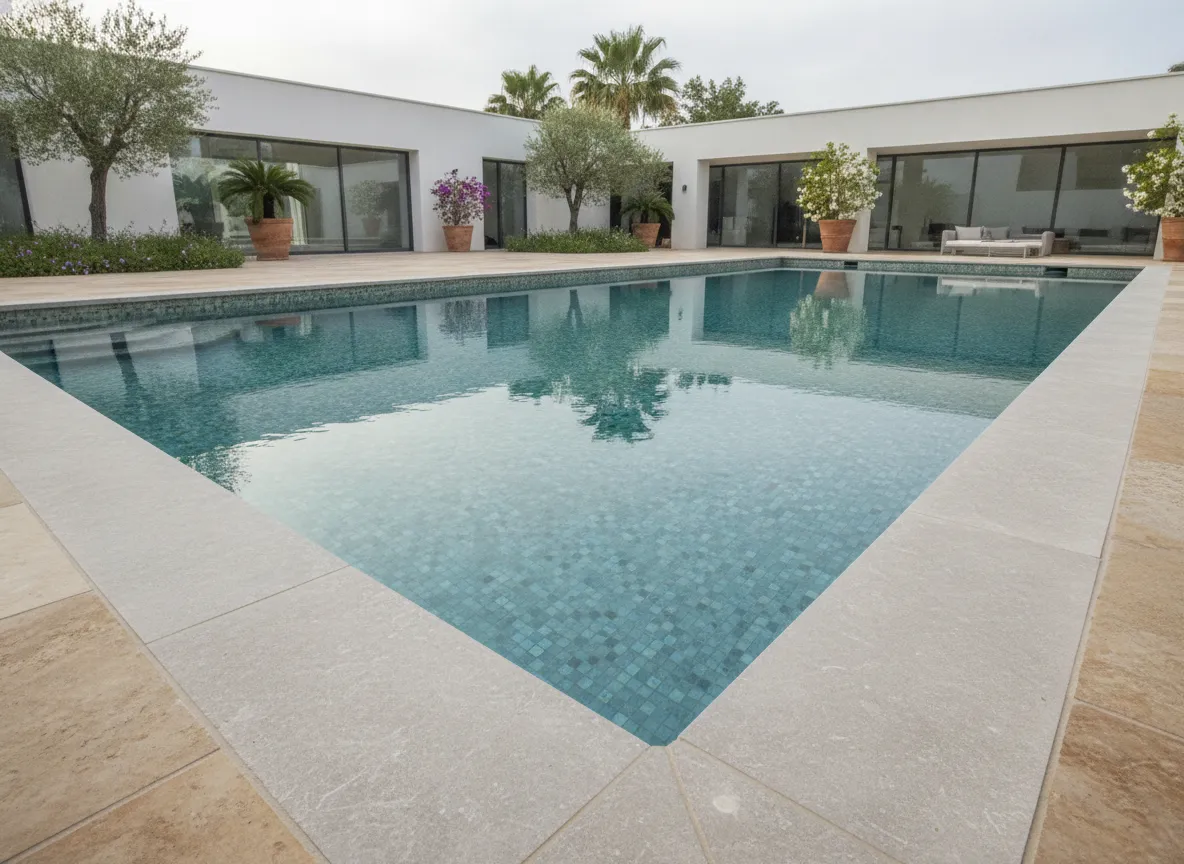
Raw soil or worn lawn occupies space where an engineered swimming structure belongs. Open ground gathers blown debris and weeds throughout hot dry summers across the Costa del Sol.
We excavate ground to solid bedrock to receive steel grids, pneumatic gunite concrete, and continuous waterproof membranes. Plumbing lines connect directly into automatic filtration units, surrounded by flush coping stones that blend into adjacent paving.
The finished basin delivers certified structural strength ready for daily swimming. Non-slip porcelain tiles resist sun degradation and hard water scale.
The precise construction sequence from bedrock to water
Plot assessment and levels are surveyed — We calculate ground contours and subterranean bedrock depth before machinery arrives on site. Soil stability dictates structural calculations and municipal permit submissions.
Basin footprint is excavated into bedrock — We use heavy machinery to dig the structural pit down to operational depths. Solid substrate must support the intended water weight.
Steel rebar cage is tied throughout — We install a double-grid framework of high-tensile steel mesh across walls and floor. Spacers keep the steel suspended so concrete fully encapsulates every bar.
High-density gunite concrete is sprayed pneumatically — We blast concrete continuously under pneumatic pressure to produce a dense shell.
Pressure-tested PVC pipework is embedded — We install and pressure-test high-pressure circulation lines, floor drains, and skimmer housings before sealing. Dedicated returns ensure complete circulation without dead spots.
Multi-layer waterproofing barrier is applied — We apply elastic cementitious waterproofing across the entire inner surface of the cured gunite shell. The continuous membrane prevents subsurface water transmission into the concrete matrix.
Porcelain mosaic tiles are fixed — We lay vitrified ceramic or porcelain mosaics using pool-grade underwater adhesives and epoxy grout. Coping stones are leveled flush with adjoining areas like new patio and terrace construction.
Filtration equipment is connected and started — We carry out initial pressure calibration on glass-media filters, multi-speed pumps, and chemical dosing systems. The basin fills completely, allowing chemical balancing to stabilize water before first use.
We cover the Costa del Sol
Structural excavation, basin engineering, and pool construction cover coastal residential communities and hillside estates.
Is this what you are looking at?
Steep slopes dropping behind the terrace
Natural garden drop-offs leave insufficient level ground for standard sunken basins. A reinforced cantilever wall transforms the steep incline into an open horizon edge, provided bedrock anchors are bored early.
Narrow side gardens shaded by walls
Tight boundary lines restrict traditional wider footprints and limit daytime sun exposure. A slender swimming corridor restores usable swimming length, usually fitting neatly beside existing villa boundaries if underground services permit.
Exposed lawns viewed from higher properties
Overlooking neighbouring villas remove personal seclusion across open flat lawns. Dropping the poolside profile down into a sheltered garden courtyard restores complete sunbathing privacy, as long as drainage channels carry away heavy rain.
Sandy garden soil washing into trenches
Loose coastal subsoil collapses inward during digging and fails to support vertical earth faces. Shuttered retaining walls keep the excavation stable while concrete cures, giving you a firm, permanent foundation without bank slippage.
Wet ground weeping through garden terraces
Underground hill runoff gathers against buried retaining walls long before any pool digging begins. Dedicated deep gravel sumps relieve this subterranean hydrostatic water pressure, protecting your empty basin from floating or cracking later.
Does your villa need steady exterior care?
Response time: 24 hoursSatisfaction guarantee
Poured concrete or a prefabricated shell
The choice between poured concrete and a prefabricated fiberglass shell comes down to installation speed versus custom shaping. Fiberglass pools arrive as factory-molded shells ready to be lowered directly into an excavated hole. Site prep, excavation, and setting a fiberglass shell take between 1 and 3 weeks. However, the pool shape is restricted to predetermined factory dimensions that can travel by road.
Poured concrete or gunite allows any shape, depth, or integrated feature your garden requires. The structural shell takes between 6 and 12 weeks to complete because the concrete requires several weeks of curing and waterproofing before water can go in. A poured concrete structure lasts 40 to 50 years with surface replastering every 10 to 15 years, whereas fiberglass shells last 25 to 35 years before the surface needs attention.
Excavation routes determine mini diggers or heavy machinery
Getting earthmoving equipment into your garden sets the pace for the entire build. Standard diggers and full-size dump trucks require open access tracks and wide entrance gates. When passageways around the house are restricted, standard plant simply cannot pass through. Trying to force standard machinery through narrow passages damages boundary walls and garden paving, leading to unexpected repair costs.
Excavating a standard pool basin takes 1 to 3 weeks when heavy trucks move soil directly from the pit. If your side passage is narrow, specialized mini machinery or crane lifts are required to hoist equipment and soil over walls. Standard equipment keeps soil removal moving fastest when access roads accommodate large trucks, while confined garden passageways require mini diggers or mobile crane lifts that add machinery stages to the schedule.
Bedrock and groundwater levels in your garden
A site inspection checks the underground conditions where your pool structure will rest. The test examines the ground for solid subsurface bedrock. When the ground reveals solid stone, hydraulic hammering is required to break the rock before any earth can be hauled away. This adds mechanical breaking as a separate line item and extends excavation beyond the normal 1 to 3 weeks. Ordinary dirt avoids this extra mechanical stage entirely.
The visit also measures the natural groundwater table elevation on your plot. High groundwater exerts extreme pressure that can shift, crack, or lift an empty concrete shell right out of the ground. When high water levels are present, we add continuous dewatering and permanent hydrostatic relief valves to your quote along with perimeter drainage lines. Normal dry soil requires only the standard shell drainage base, saving those extra water-management items.
Your questions, answered
How long does a new swimming pool last? +
A reinforced concrete structure lasts 40 to 50 years or more. Surface finishes need renewal sooner, with interior plaster or tiles typically requiring resurfacing every 10 to 15 years. Fiberglass alternatives generally provide a service life of 25 to 35 years.
What early signs indicate structural pool damage? +
Fine surface cracking or shifting around the coping often signals unmanaged water pressure beneath the shell. Around the Costa del Sol, underground plumbing leaks frequently start with minor soil settlement around pipe bedding, causing steady, unexplained water loss before larger deck cracks appear.
What makes one pool installation more expensive than another? +
Equipment choices and heating systems drive the final cost up significantly. Choosing automated safety covers, saltwater electrolysis, or advanced filtration creates a wide price difference between two pools of identical dimensions.
Are saltwater pools completely free of chlorine? +
No, saltwater systems actually sanitize the water by generating chlorine on-site through electrolysis. In coastal villas across Marbella, many owners expect zero chlorine, but the cell simply converts dissolved salt into standard sanitizing chlorine to keep the water clear.
Can a pool be built on uncompacted ground? +
No, we reject constructing any pool on uninspected, uncompacted fill dirt without an engineered foundation. Without solid ground bearing or proper dewatering systems where groundwater is high, the structure risks severe cracking or shifting over time.
Which pool structure should be chosen for a garden? +
The choice stands between reinforced concrete, fiberglass shells, or vinyl liners. Concrete allows fully custom shapes and maximum rigidity for any layout, while pre-molded fiberglass installs quickly but remains restricted to factory dimensions and standard road transport limits.
What happens if I am not happy with the new pool construction? +
Satisfaction guarantee. If you are not happy with a result, tell us and we come back to put it right.