Clear ceramic tiles free of chalky calcium bands and greasy scum
A clean, uniform waterline without chalky bands
Careful mineral dissolution removes the chalky grey scale that catches the eye from the terrace. The glass mosaics regain their original, vibrant colour without cloudy chemical residue.
Intact grout joints and secure mosaic tiles
Clearing out aggressive mineral buildup relieves pressure along the ceramic seams. Mosaic squares stay firmly anchored to the pool shell, preventing water from getting behind the tiles.
Smooth ceramic surfaces that repel swimming oils
Polishing the tile glaze eliminates the rough texture that scratches skin and traps sun cream. The sealed perimeter stays slick, making daily routine pool maintenance faster and more effective.
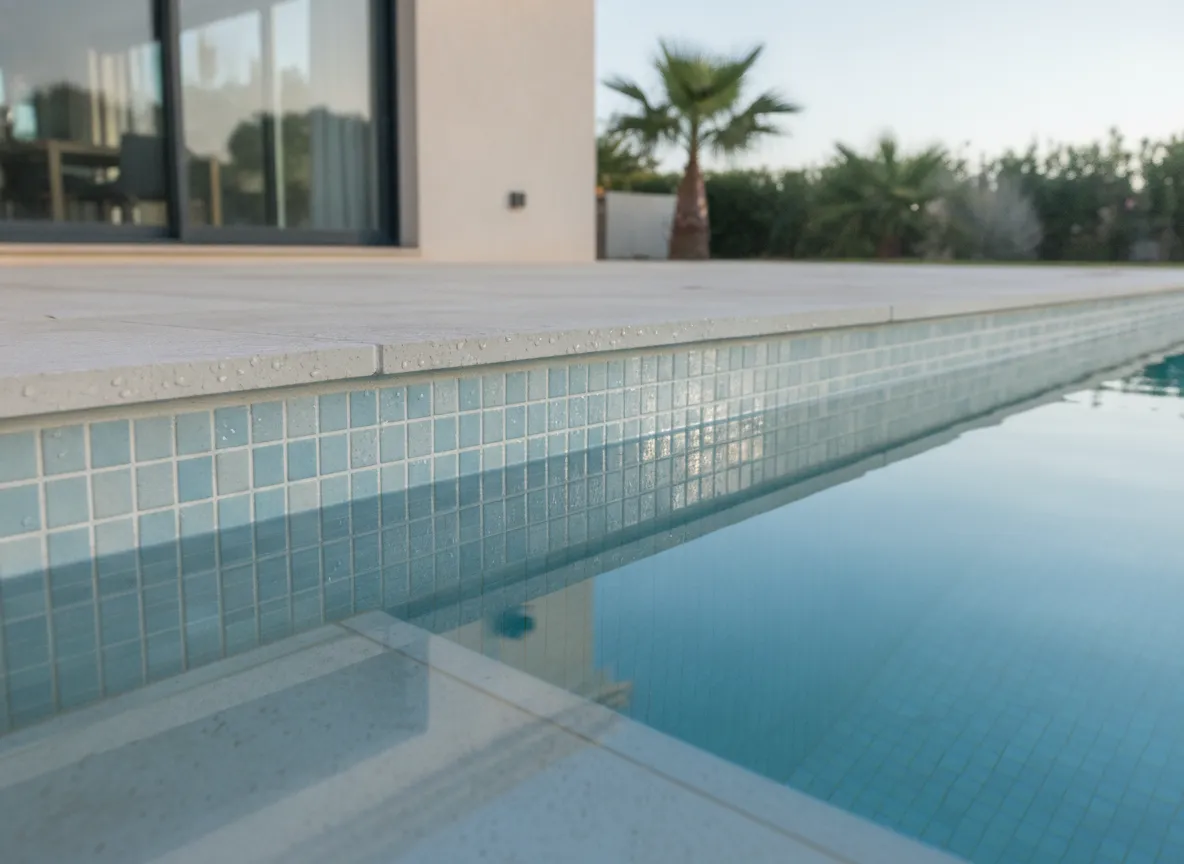
Sunlight evaporates pool water along the edge, leaving thick calcium crusts behind. In areas like Nueva Andalucía, calima dust mixes with minerals to create a stubborn grey line. This hard residue easily resists standard brushing.
Grease from sun creams bonds directly to hot ceramic glaze during dry summers. The waterline turns into a dark, rough strip that traps organic material and feeds persistent algae blooms.
Left untreated, hardening minerals force their way into the joints between glass tesserae. Water seeps behind loosened tiles, popping them off the substrate and creating costly replastering and retiling work.
Surface assessment and lowering the water before mineral removal
The pool water is lowered ten centimetres — We drop the surface below the calcified waterline to expose the entire mineral band. The exposed surface dries out slightly to reveal every hard limescale deposit.
A thick descaling gel is applied — We apply targeted descaling gel to mineral deposits without running freely down the pool wall. The formula stays active for fifteen minutes to soften the calcium.
The calcified glaze is scrubbed clean — We loosen limescale with mineral pads and soft brass scrapers without etching delicate glass glaze. Hand scrubbing clears embedded grit directly from the grout channels.
Loosened slurry is removed with an external vacuum — Our industrial wet extractor collects the softened limescale slurry directly from the tiles. None of the dissolved mineral runoff enters the main pool water.
Clean water flushes the exposed band — A low-pressure fresh water rinse cleans away remaining descaling residue. We inspect the clean tile band to check that every stubborn white crust has cleared completely.
Exposed joints are checked for structural damage — Tapping the tile line reveals hollow voids, fractured grout, or loose mosaic tesserae. We mark damaged sections for tile, grout and joint repair.
A hydrophobic shield is polished into the glaze — We wipe a protective seal across the smooth ceramic surface. The barrier impedes future mineral adhesion and stops atmospheric calima dust from sticking.
The water level is restored to the skimmers — Fresh water tops the pool back up to operational skimming height. Normal filtration restarts once we check and balance the water chemistry. The surface is ready for swimming.
We cover the Costa del Sol
Scheduled waterline maintenance and exterior cleaning extend across detached properties along the coastal corridor. Every villa receives structured care visits tailored to its specific pool construction and water hardness.
Is this what you are looking at?
Tan scum floating against edge tiles
Bather cosmetics combine with surface pollen and bake against warm ceramics during calm afternoons. Gentle dissolving agents lift this film completely, provided the oily layer has not baked into porous silicone seals.
Missing mosaic squares beneath the coping
Ground vibration and chemical aging degrade the flexible adhesive holding individual pieces to the pool shell. Spot bonding resets loose sections flush with surrounding areas, as long as the underlying render remains firm.
Crumbly mortar along underwater joints
Acidic imbalances slowly dissolve standard cement compounds between tiles over several swim seasons. Fresh waterproof compound restores these channels securely, leaving smooth joints that keep pool water away from raw substrate.
Rough green patches on step edges
Poor water circulation allows hardy spores to anchor firmly into microscopic crevices along tile treads. Contact clearing lifts the growth cleanly, restoring uniform colour if action is taken before roots penetrate the grout.
Bulging tiles lifting away from walls
Trapped moisture expanding behind ceramic surfaces gradually forces entire sections away from concrete walls. Early resetting secures the perimeter before winter water penetration causes large sections of wall mosaic to fall away completely.
Does your villa need steady exterior care?
Response time: 24 hoursSatisfaction guarantee
Large porcelain pieces or small glass mosaic tiles
Waterline tiles face continuous chemical exposure and intense sun. Selecting materials requires looking at long-term durability and surface absorption. Fully vitrified porcelain tiles have a water absorption rate under 0.5 percent, making them exceptionally tough against pool water. They cover large areas quickly, keeping installation labor hours lower across standard residential perimeters.
Glass mosaic tiles create classic visual depth, but they introduce far more joint lines and specific technical demands. Glass requires specialized paper-faced or mesh-free backings, because standard mesh glue often dissolves under water. Aligning thousands of tiny individual pieces increases the setting time from a single day up to three full days.
Porcelain tiles keep installation labor and material spend low on standard budgets. Our recommendation is glass mosaic for projects where the installation budget accommodates the extra time for precision alignment and specialized submerged adhesives. Overlooking these backing requirements leads to tiles falling off, requiring expensive strip-outs and premature replacement.
Routine inspection of the top movement joints
The flexible joint beneath the pool coping absorbs constant expansion between the pool shell and surrounding deck. While standard cementitious grout lasts 5 to 10 years before requiring repairs, top movement joints use neutral-cure, chlorine-resistant silicone that lasts 3 to 5 years. Direct sun, pool chemicals, and constant movement degrade this flexible seal over time.
Leaving an existing joint intact is safe when an annual inspection shows the silicone remains firmly bonded, soft, and completely free of splits. Once the bead hardens, separates from the tile edge, or tears, chlorinated water creeps behind the waterline beam. Water entering behind the tile face causes the render to soften and bond failure to spread.
Our recommendation is replacing the perimeter flexible sealant every 3 to 5 years to prevent costly water migration. Keeping the existing joint intact is fine as long as inspection shows zero detachment. Ignoring split joints allows water behind the bond beam, turning a quick sealant job into costly structural tiling repairs.
What an on-site inspection settles for your quote
Tapping the waterline reveals whether tiles are still bonded to the concrete beam. A hollow echo or slight movement means the mortar bed has failed underneath. When tiles have debonded, re-grouting alone is never an option, and our quote adds complete tile resetting before any joint work begins. Solid tiles with tight adhesion require only cleaning and joint renewal.
A two-meter straightedge placed against the bare waterline checks the straightness of the concrete beam. If the gap under the edge is under 3 mm, tiles can be fixed straight onto the wall with standard mortar thickness. If the concrete deviates by more than 3 mm, we add mechanical grinding and leveling as a separate preparation stage on the quote, adding one to two days to the project schedule.
Your questions, answered
What makes waterline tiles last longest, and what ruins them? +
Stable water balance protects the installation longest. Acidic water with low pH eats away cementitious joints rapidly. Refilling the pool before the mortar cures—which requires 7 to 21 days—also dissolves uncured cement and destroys adhesion.
Does pool tiling work require special permits or licenses? +
Setting the tiles does not require a trade license, but pool drainage and structural work do. Modifying the pool shell or bond beam involves local building codes. Discharging chemically treated pool water or acid runoff into municipal drains also requires local environmental permits.
What factors make one waterline tiling job more expensive? +
Choosing two-component epoxy adhesive and grout adds material costs and doubles application labor compared to cement products. Damaged concrete or failing render requires structural repairs billed separately. High pool walls, elevated spas, and difficult access also increase the total work hours.
What issues develop first when waterline tiles begin failing? +
Tiles sound hollow when tapped, which happens before they detach entirely. White calcium crusts also seep through joints when moisture migrates through concrete. In exposed villas across the Costa del Sol, intense sun exposure accelerates debonding if joints lack full mortar coverage.
What condition must the pool wall meet before retiling? +
The concrete base must be fully cured, structurally sound, and free of active cracks. Surface deviation must stay under 3 mm over a 2-meter straightedge. Applying tiles over shifting concrete or failing render causes the new installation to debond rapidly.
How long do new waterline tiles and joints typically last? +
Porcelain or glass tiles installed with epoxy grout last 15 to 25 years or more. Standard cementitious grout lasts 5 to 10 years before requiring attention. In coastal villas in Benalmádena, harsh sun and heavy pool usage mean flexible joint sealants require renewal every 3 to 5 years.
What happens if I am not happy with the pool tile cleaning? +
Satisfaction guarantee. If you are not happy with a result, tell us and we come back to put it right.