An outdoor kitchen built for decades of coastal use
Acid-resistant steel without surface rust
All doors, drawer runners, and grill fireboxes use AISI 316 marine-grade stainless steel. The alloy resists constant airborne salt along coastal plots, maintaining a smooth finish without pitting or corrosion.
Worktops that resist calima dust
Sintered stone and porcelain slabs absorb neither cooking grease, red wine, nor fine Saharan sand. Surfaces wash clean with plain water and a cloth, requiring no chemical sealers or specialized cleaners.
Hardwired power and plumbed water
Dedicated utility runs inside the masonry island remove the need for garden hoses and extension leads on the terrace. Food preparation, handwashing, and refrigeration run on properly grounded lines.
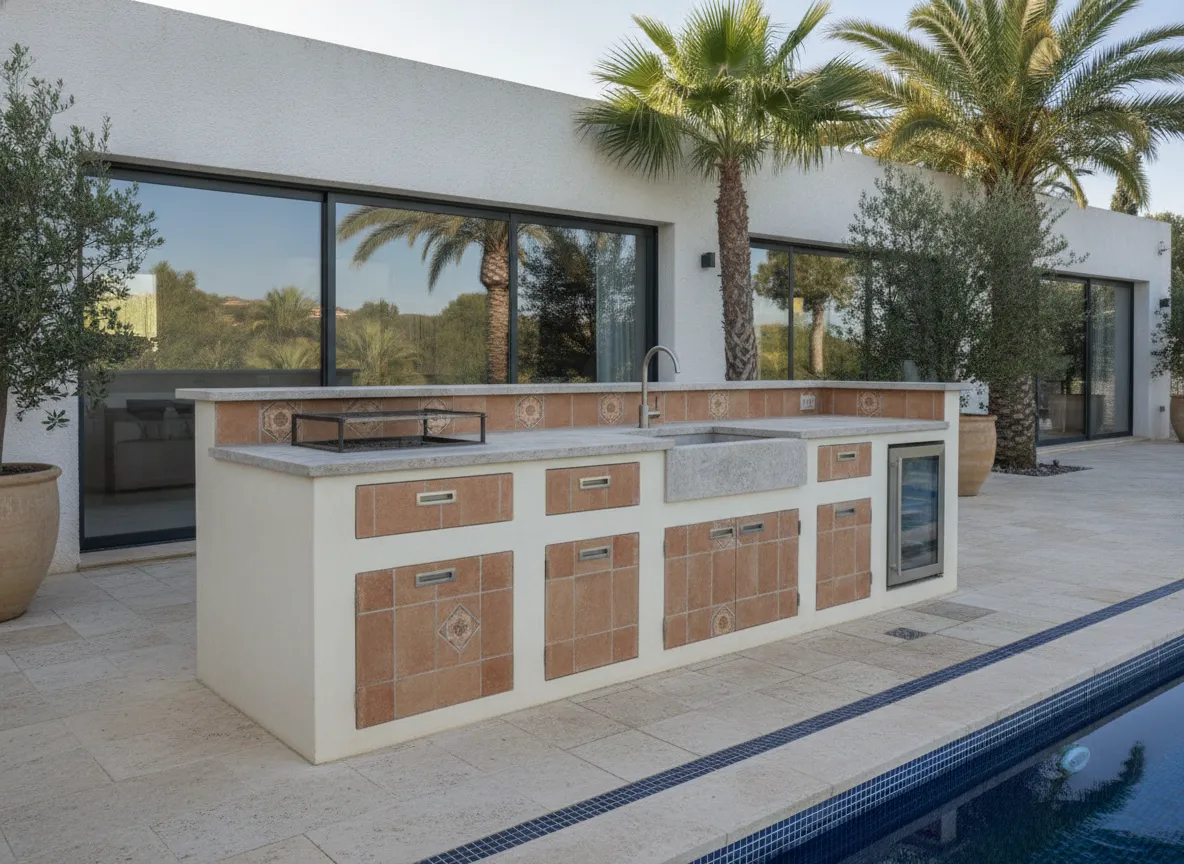
Carrying cookware and prep tools from an indoor kitchen out to an exposed patio quickly becomes tedious. Freestanding barbecues lack cold storage, plumbed water, and sufficient prep space. Across the Costa del Sol, outdoor kitchen construction replaces mobile grills with permanent masonry counters. Marine-grade cabinetry, non-porous sintered worktops, and dedicated drainage create a reliable workspace for villa cooking.
Selecting low-grade metals or porous granite leads to salt corrosion and stubborn grease staining under direct Mediterranean sun. Proper structural brickwork and sealed utility runs keep the installation functional year-round.
From initial survey to finished outdoor kitchen
Terrace load capacity and drainage fall are assessed — We inspect the base slab for load stability, adequate fall toward drains, and shelter from prevailing winds. The layout sets the trenching route for water and power lines from the main villa supply.
Utility lines are trenched and laid — We run PEX water pipes, waste drainage, and armored electrical cables directly to the kitchen island position. Proper pipe sizing prevents pressure drops and ensures certified supplies for refrigeration, induction hobs, and lighting.
The masonry core is laid in concrete blocks — We build the base with damp-proof membranes and reinforced blocks that resist thermal expansion.
Weatherproof render is applied — We render and coat exterior faces with breathable masonry finishes matching the villa's existing walls. This layered render stops salt efflorescence and surface flaking.
Sintered stone worktops are installed — We cut non-porous porcelain or sintered stone slabs to millimeter tolerances and fix them using UV-stable adhesive. The surfaces handle hot pans, acidic spills, and intense midday sun without discoloration or cracking.
Marine-grade 316 stainless fittings are set — We level and seal grills, sinks, taps, and access doors in 316-grade steel against windblown dust. The alloy resists corrosion from salty coastal air.
Water, gas, and power lines are tested — All pipework undergoes pressure testing, waste lines are checked for flow, and electrical breakers are tested under full operational load.
We cover the Costa del Sol
Outdoor kitchen installations are constructed across coastal villas, focusing on weather-resistant masonry and marine fittings.
Does your villa need steady exterior care?
Response time: 24 hoursSatisfaction guarantee
Is this what you are looking at?
Loose hinges sagging on cabinet doors
Salt spray and constant terrace heat dry out standard fasteners until they work loose from the base. Resetting them into solid plugs keeps the frames aligned, provided the underlying blockwork has not started crumbling.
Foul smells rising from sink waste
Unused terrace waste traps dry out quickly under intense sun, letting underground pipe gases vent straight upward. Flushing and fitting an inline dry-seal valve stops the odor completely once the trap maintains a continuous seal.
Uneven yellow flames under the burners
Tiny spiders and airborne sand frequently block the burner ports after strong coastal winds. Cleaning the venturi tubes clears the supply paths, restoring steady heat if the brass valves remain free of corrosion.
Chipped edges along the countertop cutouts
Heavy cast-iron pans knocked against thin edge profiles cause small pieces to shear away. Color-matched stone resin fills the voids smoothly, though exact shade matches become harder on surfaces bleached by long sun exposure.
Horizontal crack opening below worktop slab
Intense summer heat causes the worktop and base structure to expand at different rates, splitting rigid mortar seams. Replacing the brittle joint with flexible waterproof silicone prevents rainwater from penetrating down into the masonry core.
Cabinet airflow vents are essential for gas safety
Enclosed outdoor kitchen islands often house gas shutoff valves, pipework, or refillable gas bottles. Weatherproof cabinet doors keep rain away from cooking gear, but completely airtight cavities create dangerous conditions around gas connections. A tiny leak in an unvented void allows gas to pool silently inside the framing. Trapped heat from daytime sun and nearby cookers makes the danger worse.
High-and-low ventilation cutouts are mandatory whenever gas lines, cylinders, or valves sit inside an island base. Vents installed near the top and bottom ensure natural air circulation that disperses heavy fumes immediately. We strictly limit fully sealed storage runs to dry utility cabinets that contain zero gas connections, eliminating the risk of combustible gas accumulation.
Concrete blocks or light steel frames for island construction
Building an outdoor cooking island starts with a choice between solid masonry blockwork and light metal framing. Concrete masonry units create immense structural mass, but the poured foundation and mortar joints demand a full 21 to 28 days of curing before supporting heavy granite or sintered stone slabs.
Light-gauge steel framing with cement backer boards bypasses that extended wait time entirely. The metal framework, utility rough-ins, and boards assemble in 3 to 5 working days, making steel modules ideal when rapid completion is necessary. Concrete masonry units suit projects where schedules accommodate the month-long curing window, securing a solid structure that lasts for 25-plus years without risking cracked countertop joints from premature loading.
Your questions, answered
Where is it safe to save money on an outdoor kitchen? +
Exterior porcelain tiles cut finish costs safely. Trimming money on the foundation or choosing standard steel hardware leads to expensive repairs. Zinc-plated screws or 430-grade parts rust solid within one to two seasons, while improper footings cause cracked counters.
How long will an outdoor kitchen build actually last? +
Properly built structures and sintered stone surfaces last over 20 to 25 years. Countertops remain solid as long as the sub-frame does not shift. Topical concrete sealers and silicone joints need renewing every few years to keep moisture out.
Can standard indoor quartz work on an outdoor countertop? +
Standard quartz fails quickly outdoors. Under the intense sun along the Costa del Sol, UV rays break down synthetic binding resins, turning surfaces yellow and forming micro-fissures within months. Exterior kitchens require dense natural granite, concrete, or UV-stable sintered stone.
What determines the choice of countertop material? +
Heat exposure and weather resistance guide the decision. Sintered stone withstands hot pans and sun, but requires strict support within 2 to 3 mm over a two-meter straightedge. Cast concrete offers a solid custom fit, provided it is properly sealed against stains.
Do gas and power hookups require certified trades? +
Yes, utility hookups demand certified professionals. In coastal villas across Marbella, running dedicated gas lines requires an authorized gas installer for pressure testing. Electrical consumer circuits with outdoor RCD breakers also require a licensed electrician to ensure fire and shock protection.
Can an outdoor kitchen sit directly on existing patio tiles? +
No, heavy kitchen islands cannot sit on unreinforced floating pavers. Hundreds of kilograms of appliances and masonry will cause unanchored paving to settle unevenly. The base slab must feature a 1-2% fall away from cabinet bases to stop standing water accumulating.
What happens if I am not happy with the outdoor kitchen construction? +
Satisfaction guarantee. If you are not happy with a result, tell us and we come back to put it right.