No more loose boards, splinters, or hidden structural rot
Damaged deck boards replaced
We replace warped, splintered, and rotted boards with matching timber cut to fit the existing layout. The surface sits level and drains water away from pool edges without pooling.
Subframe joists reinforced and levelled
Substructures are cleared of soft rot and strengthened where joists carry heavy loads. Marine-grade fixings ensure the framework remains rigid even in humid coastal conditions.
Sanded and sealed against sun damage
We sand the wood flat and saturate it with exterior oils designed for harsh Mediterranean sunlight. The renewed surface repels calima dust and prevents future moisture absorption.
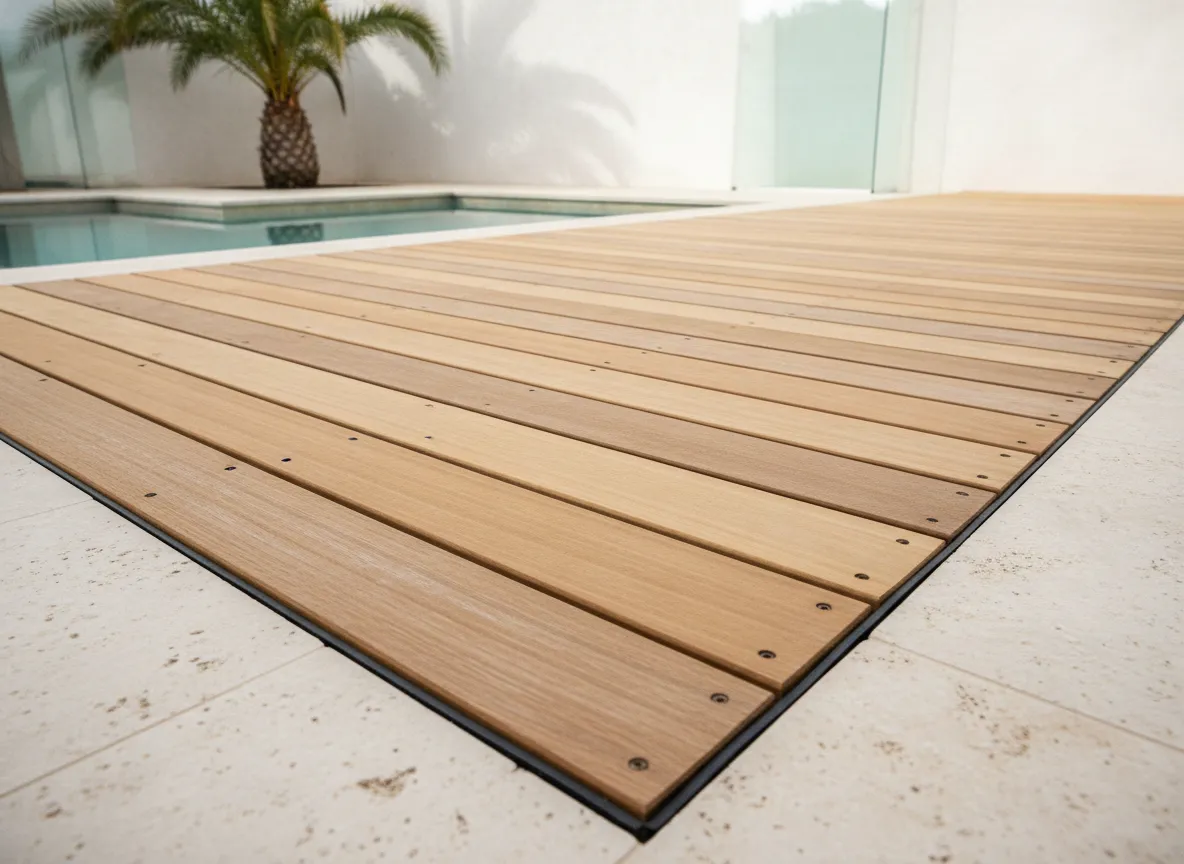
Sun exposure bakes exposed boards daily, splitting the grain and loosening fixings until walking barefoot becomes dangerous. Splinters and raised screws cause injuries around the pool while loose boards tilt under foot.
Trapped moisture rots the unseen subframe joists underneath. When internal beams soften, entire sections collapse without warning. That turns a simple board swap into a complete structural rebuild.
Along the coastal villas of Mijas and Marbella, fine calima dust settles deep into weathered wood grain. Combined with salt air and winter damp, unattended timber surfaces deteriorate twice as fast.
How timber structures are restored and protected
Structural sounding identifies concealed rot — We check boards and underlying subframe joists with a probe to locate soft spots.
Decayed timber members are removed — We cut back compromised joists and cracked deck boards to solid, healthy timber. Replacement pieces are shaped to match existing dimensions precisely.
Marine-grade fixings are installed — We extract corroded exterior screws from the subframe. Marine-grade A4 stainless steel fixings secure the structure against salt air and chlorine splashback.
Surfaces are sanded back to sound wood — Heavy mechanical sanding strips off grey, UV-damaged surface fibres. We smooth the bare timber flat to eliminate dangerous splinters and raised edges.
Dust and debris are extracted — We clear grooves and timber joints of sanding dust and fine calima dirt. Clean timber pores are required for exterior oils to bond correctly. This step ensures deep, uniform oil absorption across the deck.
Protective solar-barrier oil is applied — We work deep-penetrating timber oil formulated for high UV exposure into the boards. The coating seals against driving rain, pool water, and strong sun.
We cover the Costa del Sol
Timber repair and structural restoration services cover detached villas and private residences across the coastal region.
Is this what you are looking at?
Springy boards sinking under foot
Frequent foot traffic over weakened support spans causes planks to bow downward when stepped on. Individual sections can usually be stiffened from underneath if the surrounding framework remains solid.
Wobbly railing shaking when touched
Seasonal temperature shifts cause fixing points at upright post bases to widen and lose grip. Tightening or resetting the base anchors secures the railing before the joint splits completely.
Shrunk planks showing wide gaps
Intense summer heat bakes natural sap out of the timber, making individual planks contract unevenly. Resetting the spacing restores an even surface across the deck, provided the edges haven't curled.
Sharp raised splinters catching bare feet
Repeated drying cycles lift the top wood grain into brittle upright needles. Surface smoothing removes the rough layer and keeps the boards comfortable, assuming the damage is purely surface-level.
Dark damp shadows between plank seams
Poor airflow in narrow joints traps evening condensation against the unventilated bearer timbers. Catching this dampness early prevents hidden rot from spreading into the foundation posts below.
Does your villa need steady exterior care?
Response time: 24 hoursSatisfaction guarantee
Hardwood or softwood boards for replacing worn deck planks
Replacing damaged decking boards always brings up the question of timber species. Pressure-treated softwood planks keep the initial raw material expenses low and install quickly. However, standard pine or spruce needs regular oiling and surface treatments to handle intense southern exposure. Without this continuous care, the boards cup, crack, and fail prematurely under strong sun and outdoor wear.
Dense hardwoods like cumaru or ipé naturally resist decay and stay dimensionally stable over decades. They require pre-drilling and high-grade A2 or A4 stainless steel fixings to prevent split ends and head pull-through, which increases upfront labor and material costs. Swapping isolated planks normally takes 2 to 4 hours, but choosing an unsuitable timber creates mismatched weathering and leads to early repeat repairs.
Naturally durable hardwood planks match expectations when planning for a 20 to 30 year lifespan, while pressure-treated softwood planks serve as a practical 10 to 15 year solution at a lower initial raw material cost.
How to tell if joists need protective tape
Lifting worn deck boards often reveals the condition of the wooden subframe underneath. A common assumption is that the supporting frame outlasts the surface planks. In practice, substructure timber often decays first because rainwater and morning moisture seep into the narrow gaps between the boards and joists, sitting directly on the horizontal beams without evaporating.
Unprotected structural timber exposed to trapped moisture develops joist rot under the deck surface. Once fungal decay takes hold of the structural beams, sistering or replacing the decayed joists takes 1 to 3 days of labor. This repair costs substantially more than a standard top-board replacement, as it involves leveling posts and securing framing ties. We apply a durable joist tape to create a continuous waterproof barrier across the top edge of each beam before laying new timber.
Protective joist tape application stops hidden water traps and extends the subframe lifespan to 20 or more years, while unprotected framing remains exposed to trapped moisture that typically causes rot within 8 to 12 years.
Platform height, wall connections, and frame load capacity
During our site visit, we check whether structural alterations exceed local platform height thresholds or require anchoring a new ledger board directly through the home exterior wall. If the work involves elevated framing above code limits or changes primary structural anchors, your quote includes structural calculations and the necessary building permit process. If the repair only replaces surface boards or low-level framing, work proceeds as a direct repair without administrative delays or permit filing costs.
The visit also verifies the structural load requirements of any damaged ground-level framing. When a timber member must carry active deck bending loads, the estimate specifies pressure-treated structural softwood to preserve code-compliant strength. If the component serves strictly as non-structural cladding with minimal moisture absorption, thermo-treated wood can be used, keeping structural timber posts and engineered framing out of the pricing scope.
Your questions, answered
Do timber repairs require official building permits? +
Repairing surface boards and non-structural timbers does not require permits. Structural modifications to elevated decks exceeding local building code height limits require formal permits and structural calculations. Attaching new ledger boards to primary dwellings must also meet building regulations for moisture barriers.
Is pressure-treated exterior wood completely waterproof? +
No, pressure treatment prevents rot and insects, but the wood remains porous. It requires regular protective sealing and mandatory end-grain sealing whenever cut. Without surface protection, moisture still penetrates the grain, causing dimensional swelling and premature surface checking.
What base conditions must be met beneath the timber? +
Ground pads must rest on undisturbed, load-bearing soil to prevent shifting. Structural joists require continuous ventilation and adequate ground clearance to stop moisture rising from the earth. In coastal microclimates around Marbella, trapped humid air under poorly ventilated decks rapidly accelerates decay.
How long do typical timber repairs take to complete? +
Replacing isolated damaged boards takes us 2 to 4 hours, including fastener extraction. Structural joist repairs generally take 1 to 3 days depending on access. In the dry climate of the Costa del Sol, wood glues and end-grain seals cure fully within 24 to 48 hours.
Where can money be saved without risking structural damage? +
Opting for pressure-treated softwood over imported hardwoods significantly cuts material costs. However, saving money on cheap fasteners causes rapid failure. Only A2 or A4 marine-grade stainless steel screws prevent corrosion, whereas zinc-plated screws rust through outdoor timber prematurely.
What are the earliest warning signs of deck decay? +
Early decay often shows as cupping boards or screw heads pulling through the surface timber. This typically points to inadequate board gaps or hidden joist rot developing directly beneath the planks. If non-ground-contact timber touches soil, fungal decay begins silently at ground level.
What happens if I am not happy with the deck and timber repair? +
Satisfaction guarantee. If you are not happy with a result, tell us and we come back to put it right.