A self-running garden that stays green all summer
Automated watering for distinct plant zones
Lawns, citrus trees, and flower beds receive individualised run times through dedicated valves. Scheduled cycles run without manual intervention, protecting plant health while the property sits vacant.
Lime-resistant drip emitters
Pressure-compensating drippers and inline disc filtration resist heavy mineral deposits found in local mains supplies. Emitters deliver precise flow rates year after year without scaling shut, blowing off fittings, or pooling water.
Measured water efficiency
Sub-surface delivery and targeted root-zone emitters eliminate evaporation loss caused by midday heat and coastal breezes. Water consumption drops substantially compared to handheld hose watering, staying within municipal drought consumption allowances.
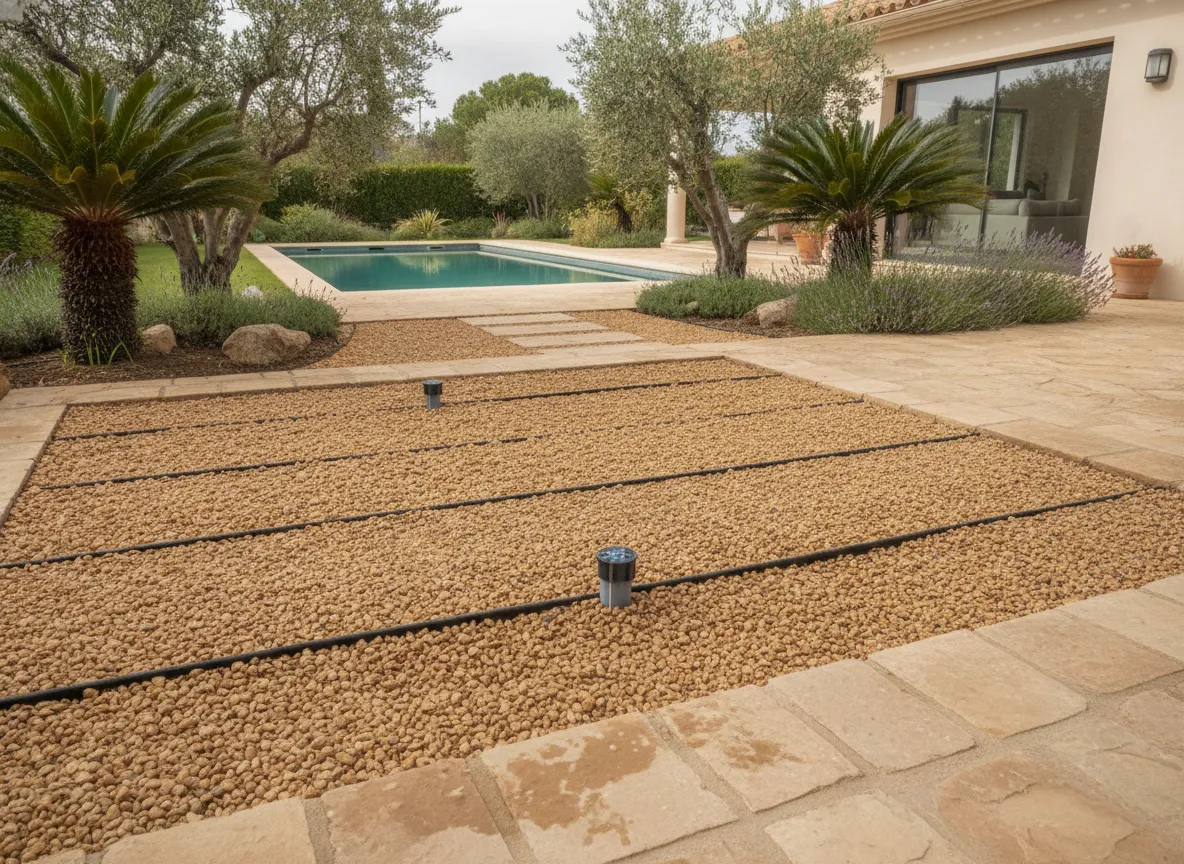
A single missed heatwave burns citrus, mature bougainvillea, and lawn beyond recovery while the villa stands vacant for months. Replacing established Mediterranean planting costs thousands and requires years of re-growth.
Hard tap water on the Costa del Sol rapidly calcifies cheap nozzles, causing hidden line blockages. Roots dry out unnoticed while surface soil appears damp, leading to dead hedge sections and browned turf.
Over-watering unzoned beds wastes expensive metered water and risks penalties under local drought limits. Soggy ground causes root rot in palms, while inadequate pressure leaves higher garden terraces completely dry.
The sequence that ensures balanced watering
Static water pressure is measured — We test flow rate and mains pressure at the boundary meter. These baseline numbers determine how many watering zones can run simultaneously without dropping line pressure.
Beds are mapped by plant type — We divide turf, palms, citrus, and shrubs into separate zones. Each group requires distinct run times, volumes, and delivery methods to thrive. This prevents under-watering or waterlogged root balls.
Supply trenches are excavated — We cut narrow channels into garden subsoil away from primary root structures. Digging to a minimum depth of thirty centimetres prevents future puncture damage during routine planting.
Rigid distribution pipes are connected — We lay durable polyethylene pipework through the trenches to feed each zone. Push-fit mechanical connectors and threaded joins are secured to withstand prolonged mains pressure.
Valves and disc filters are assembled — We house electric solenoid valves in subterranean access boxes alongside secondary disc filters.
Pressure-compensating drip lines are positioned — Drip tubing sits beneath mulch around shrubs, while pop-up sprayers sit flush with lawn edges. Regulated emitters guarantee equal output across uneven terraces.
The automated controller is calibrated — We connect the multi-station timer to a rain sensor and set it to run on seasonal schedules. We pressure-test flow rates before trenches are backfilled.
We cover the Costa del Sol
Work is completed across residential villas throughout the entire coastal corridor, from eastern hillside properties through to western beachfront estates.
Is this what you are looking at?
Dry yellow patches across turf corners
Sprinkler heads out of alignment leave dry arcs where spray arcs fail to overlap. Adjusting the spray patterns restores even coverage before the turf dies back completely.
Drooping leaves on potted terrace plants
Potted plants dry out rapidly because container soil loses moisture much faster than open garden beds. Installing dedicated micro-tubing keeps the root balls damp, provided lines are checked for mineral scale.
Water pooling inside sunken valve boxes
Worn rubber diaphragms or loose fittings let mains water bleed continuously into underground junction boxes. Replacing the internal seals stops the leak, leaving the housing dry and operational.
Fine mist blowing over boundary hedges
Excessive main line pressure shatters water streams into airborne fog that drifts away on the breeze. Fitting an inline pressure reducer restores heavy droplets so water actually reaches the roots.
Spongy wet soil between sprinkler cycles
Shifting ground or expanding tree roots crack subsurface lateral pipes, quietly saturating the surrounding earth day and night. Repairing the broken pipe section prevents sinkholes and stops hidden water loss.
Does your villa need steady exterior care?
Response time: 24 hoursSatisfaction guarantee
Standard digital clock or weather-linked irrigation control
Watering zones run through central valves that open and close based on electrical signals. A standard digital timer turns these valves on for a set number of minutes at fixed hours, regardless of whether the ground is parched or saturated from a sudden downpour. It operates on a rigid clock and requires physical intervention whenever seasonal heat shifts or unexpected rain arrives.
Smart Wi-Fi controllers connect directly to local weather forecasts and link with physical rain or soil moisture sensors in the ground. When rain falls or the soil retains adequate dampness, the unit halts watering cycles across all drip lines and lawn sprinklers. Electronic controllers typically last 5 to 10 years before internal parts require replacement.
A standard digital timer suits properties where watering routines remain strictly constant and manual seasonal changes are managed by hand. Automated adjustment to changing rainfall and soil moisture levels requires a smart Wi-Fi controller.
Digging trenches or boring beneath existing garden paths
Laying buried pipework requires a clear route from the main water supply to individual garden beds and lawn sections. Polyethylene and PVC supply lines require a smooth, stable trench floor free of sharp stones, builder rubble, and tree roots that could puncture the plastic over its 20 to 50 year lifespan. In open lawn areas, trenching and laying pipe for a standard property takes 1 to 3 working days.
Complications arise when the pipe route intersects tiled walkways, stone terraces, or concrete driveways. Cutting through finished hardscaping destroys expensive pavers, interrupts access, and creates visible joint lines that rarely match the original work. In these spots, pulling the line horizontally beneath the paved base preserves the surface completely intact.
Standard trenching works best across open soil, flower beds, and turf where backfilled earth can settle and regrow. We pull pipe directly beneath paving whenever the pipe route crosses existing hard surfaces that cannot be disturbed.
Your questions, answered
Why do installation costs vary so much between properties? +
Ground conditions and property size determine total labour. In stony soils around Marbella, trenching takes substantially longer to complete. Extra watering zones, required water supply upgrades like pumps or backflow prevention, and routing lines beneath paved driveways also increase the overall expense.
How long will an underground irrigation system last? +
Buried polyethylene and PVC lines last 20 to 50 years under typical Costa del Sol conditions. Valves and pop-up sprinkler bodies run for 10 to 15 years before internal seals need replacement. Electronic controllers and sensors generally serve between 5 and 10 years.
What protects the system best and what ruins it fastest? +
Routine filter cleaning and line flushing preserve the system by preventing root intrusion and clogged emitters. The fastest damage comes from hard water scaling, fine grit in the supply lines, or uncompacted trench soil causing sunken tracks across the lawn.
Where can money safely be saved on installation? +
Digging trenches or assembling secondary piping downstream offers safe savings on installation labour. Cutting corners on trench preparation by leaving sharp rocks or skipping dynamic pressure testing causes punctured lines, low nozzle pressure, and costly excavation repairs later.
How long does a full garden installation take? +
A standard residential installation takes 2 to 5 working days from start to finish. This covers initial flow testing, trenching, and component assembly. The system is operational immediately upon commissioning, though lawn turf over trenches needs several weeks to establish.
Can sprinklers simply be connected to an existing line? +
We never add sprinklers without first measuring flow rate and static water pressure against manufacturer specs. If the supply cannot support the required volume, pressure drops and nozzles fail to lift. The line must then be split into separate zones.
What happens if I am not happy with the irrigation system installation? +
Satisfaction guarantee. If you are not happy with a result, tell us and we come back to put it right.